Search Results for "mukbang khỉ đầu chó"
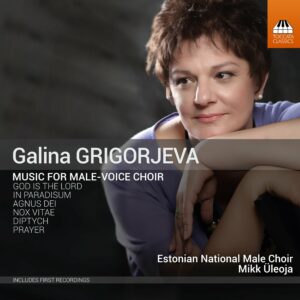
Galina Grigorjeva: Music for Male-Voice Choir
The choral music of Galina Grigorjeva – born in Simferopol in Ukraine in 1962 and based in Tallinn, in Estonia, since 1994 – is deeply rooted in the traditions of the Orthodox Church and in ancient Russian and Slavonic folklore. Although clearly by a contemporary composer, her works have a timeless, even hypnotic, quality that seems to reach back through the ages. She has been working with the Estonian National Male Choir – one of the finest in a country full of choirs – for some years now, and some of the works here were composed or arranged specifically for this recording.
Theodor Sink, cello (8, 9)
Aleksandr Mihhailov, bass (3)
Aleksander Arder, tenor (7)
Margus Vellmann, tenor (7, 9)
Grigori Rutškin, tenor (9)
Estonian National Male Choir
Mikk Üleoja, conductor
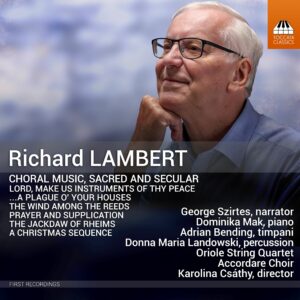
Richard Lambert: Choral Music, Sacred and Secular
The choral music of Richard Lambert, born in Bath in the English West Country in 1951, covers a wide range of expression, ranging on this album from straightforward SATB settings for church performance to a sardonic parody of the excesses of established religion. It also encompasses the timeless and the timely, with a number of contributions to the age-old tradition of Christmas music to a cantata inspired by the Covid pandemic.
This is the first recording of the Accordare Choir, founded and conducted by Karolina Csáthy, initially using former choral scholars of The Choir of Trinity College Cambridge; since then it has expanded in size, scope and accomplishment.
George Szirtes, narrator
Dominika Mak, piano
Adrian Bending, timpani
Donna Maria Landowski, percussion
Accordare Choir
Karolina Csáthy, director

Robert Fürstenthal: Complete Choral Music, Volume One
Like many Austrian Jews, Robert Fürstenthal (1920–2016) fled to the USA after the German invasion of his country in 1938. Music then became a link to his homeland: ‘When I compose, I am back in Vienna’. As an amateur composer, Fürstenthal preferred to work on a small scale, and his output of songs and chamber music is considerable. But he also wrote two sizable works for chamber choir, the first of which, in this series of two albums, is bookended by piano sonatas – all three works revealing that the tradition of Schubert and Brahms was alive in the California sun.
Ian Buckle, piano (Tracks 1–4, 16)
Richard Casey, piano (Tracks 5–10, 12–16)
Philippa Hyde, soprano (Tracks 6, 8, 12, 14)
Emma Roberts, contralto (Tracks 6, 7. 9, 12–15)
Rory Carver, tenor (Tracks 5–7, 10, 12, 14, 15)
Felix Kemp, bass (Tracks 5–7, 14)
Borealis (Tracks 5, 6, 8, 10, 13–15)
Skipton Camerata (Tracks 5–8, 10–15)
Stephen Muir, conductor (Tracks 5–15)
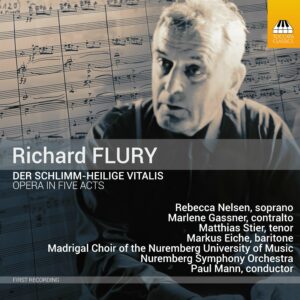
Richard Flury: Der schlimm-heilige Vitalis, Opera in Five Acts
Der schlimm-heilige Vitalis (which can be translated roughly as ‘Lustful Brother Vitalis‘) was the last of the four operas by the Swiss composer Richard Flury (1896–1967). It was premiered in 1963, the year after its completion, and then remained unheard until this recording. The plot, based on a novella by Flury’s fellow Swiss, Gottfried Keller, sets jolly village life against religious intolerance and sexual politics in an unsettling blend of the sentimental and the cynical – although love, of course, triumphs in the end. Flury’s late-Romantic music redeems the libretto with a steady flow of memorable melodies, engaging solo and choral numbers, and colourful orchestration – and with a sense of fun never far from the surface.
Rebecca Nelsen, soprano
Marlene Gassner, contralto
Matthias Stier, tenor
Markus Eiche, baritone
Madrigal Choir of the Nuremberg University of Music
Alfons Brandl, chorus-master
Nuremberg Symphony Orchestra
Paul Mann, conductor
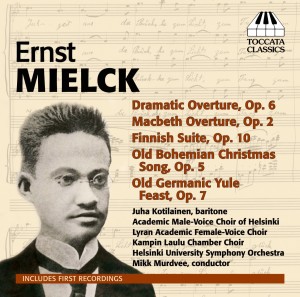
Ernst Mielck: Orchestral and Choral Works
The early death of the Finnish composer Ernst Mielck, in October 1899, two days before his 22nd birthday, robbed music of an extraordinarily gifted musician — he was also a fine pianist — and perhaps one of the major voices of the next generation: the rapid evolution in his language in the three years covered by this CD is striking. The two overtures and cantatas make clear that he was already a gifted composer in the post-Schumann Romantic tradition, and the Finnish Suite written in the last year of his life brings a striking simplification of his textures and what seems to have been a nascent nationalism.
Juha Kotilainen, baritone
Academic Male-Voice Choir of Helsinki, choir
Lyran Academic Female-Voice Choir, choir
Kampin Laulu Chamber Choir, choir
Kari Turunen, chorus-master
Helsinki University Symphony Orchestra, orchestra
Mikk Murdvee, conductor
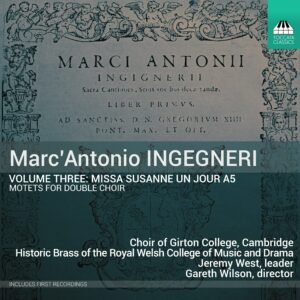
Marc’ Antonio Ingegneri, Volume Three: Missa Susanne un jour a5
The Cremonese composer Marc’Antonio Ingegneri (c. 1535/36–92) is chiefly remembered as the teacher of Claudio Monteverdi while, for well nigh 500 years, his own achievements were left to sit in the shadows. This third in a series of pioneering recordings from the Choir of Girton College, Cambridge, reveals Ingegneri to have been one of the masters of his age, writing music of breathtaking richness and beauty: the works heard here combine learned, intricate counterpoint with the kind of sheer sonic thrill that brings a shiver of physical excitement. It is, of course, religious music, but it is also extraordinarily passionate, to a degree not previously heard, nor for centuries to come, until the rise of the great Romantic choral works.
Choir of Girton College, Cambridge (1, 2, 4–6, 9–12, 16)
Historic Brass of the Royal Welsh College of Music and Drama (1–7, 9–14)
Jeremy West, leader (3)
Emily Nott, organ (8)
Felix Elliott, organ (15)
Gareth Wilson, director
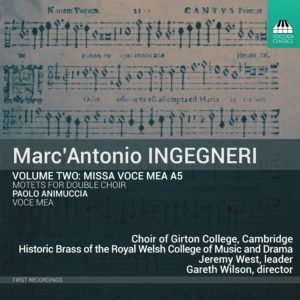
Marc’Antonio Ingegneri: Volume Two: Missa Voce Mea A5, Motets for double choir
The Cremonese composer Marc’Antonio Ingegneri (c. 1535/36–92) is chiefly remembered as the teacher of Claudio Monteverdi, while, for well-nigh 500 years, his own achievements were left to sit in the shadows. This second in a series of pioneering recordings from the Choir of Girton College, Cambridge, reveals Ingegneri to have been one of the masters of his age, writing music of breathtaking richness and beauty: the works heard here combine learned, intricate counterpoint with the kind of sheer sonic thrill that brings a shiver of physical excitement. It is, of course, religious music, but it is also extraordinarily passionate, to a degree not previously heard, nor for centuries to come, until the rise of the great Romantic choral works.
Choir of Girton College, Cambridge (Tracks 1–3, 5–8, 10, 12–14)
Historic Brass of the Royal Welsh College of Music and Drama (Tracks 1, 3–14)
Jeremy West, leader
Gareth Wilson, director
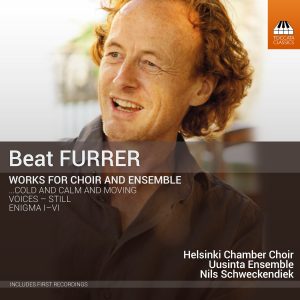
Beat Furrer: Works for Choir and Ensemble
The music of Beat Furrer, Swiss-born (in 1954) and Vienna-based, has long attracted attention for its subtle exploration of the possibilities of the human voice. This first recording of his enigmas, a cycle of six a cappella settings of Leonardo (he has since added a seventh) demonstrates its striking emotional range, from rich, almost Romantic tonal warmth to dramatic avant-garde expressionism. It is complemented by two works which underline Furrer’s fondness for exploring sonority, timbre and texture.
Helsinki Chamber Choir
Uusinta Ensemble
Nils Schweckendiek
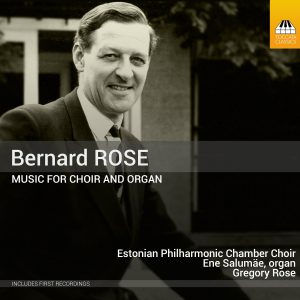
Bernard Rose: Music for Choir and Organ
As conductor, trainer and composer, Bernard Rose (1916–96) was one of the mainstays of English choral music in the second half of the twentieth century. His compositions occupy an honourable place within the mainstream of the cathedral tradition, being both grounded in the past and leaning gently into the future, and speaking its language of stylistic restraint and understated passion – and occasionally flaring into moment of considerable drama. This recording, sung by one of Europe’s leading vocal ensembles and conducted by the composer’s son, makes a good number of his works available for the first time.
Estonian Philharmonic Chamber Choir
Ene Salumäe, organ
Gregory Rose, conductor
Annike Lohmus, soprano
Karolina Kriis, soprano
Marianne Parna, contralto
Raul Mikson, tenor
Rainer Vilu, baritone

Singing Into Space: Spatially Conceived Music for Men’s Voices
The two composers heard on this album, Giovanni Gabrieli (1553–1612) and Giovanni Bonato (born in 1961) have more in common than their first names: both hail from the Veneto in north-east Italy – there is no documentation of Gabrieli’s birth, but he was probably Venetian, and Bonato was born in nearby Schio. Their music, too, is conceived in terms of its sound in space, with Gabrieli using the cori spezzati that sang from the opposing galleries of St Mark’s Basilica in Venice, and Bonato employing cori spazzializati to build a spatial dimension into the music itself. Juxtaposed, their styles offer a striking contrast, with Gabrieli’s bold declamations set against Bonato’s shifting, timeless suspensions.
Estonian National Male Choir
Mikk Üleoja, conductor
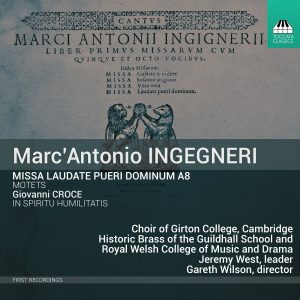
Marc’Antonio Ingegneri: Missa Laudate pueri Dominum
The Cremonese composer Marc’Antonio Ingegneri (c. 1535/36–92) is chiefly remembered as the teacher of Claudio Monteverdi while, for well nigh 500 years, his own achievements were left to sit in the shadows. This pioneering recording reveals Ingegneri to have been one of the masters of his age, writing music of breathtaking richness and beauty: the polychoral works heard here combine learned, intricate counterpoint with the kind of sheer sonic thrill that brings a shiver of physical excitement.
Choir of Girton College, Cambridge
Historic Brass of the Guildhall School and Royal Welsh College of Music and Drama
Jeremy West, leader
James Mitchell and Wayne Weaver, organ
Gareth Wilson, director
First recordings
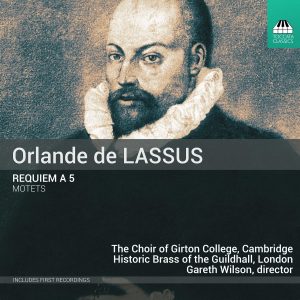
Orlande de Lassus: Requiem a 5; Motets
Lassus’ five-part setting of the Requiem is rarely heard; here it is recorded with brass for the first time, the sombre colours of the sackbuts further darkening the tone. Interweaving a number of motets, some also receiving first recordings, and a madrigal on death by one of Lassus’ contemporaries in an organ transcription, this innovative programme takes the listener on a spiritual journey, through the darkness of bereavement to the elevation of the Christian soul after death.
The Choir of Girton College, Cambridge (Tracks 1-4, 6-10, 12-14, 17)
Historic Brass of the Guildhall, London
(Jeremy West, leader) (Tracks 2-8, 10, 12-14, 17)
Lucy Morrell, organ (Tracks 3, 4, 6-8, 10-13, 16, 17)
Gareth Wilson, director
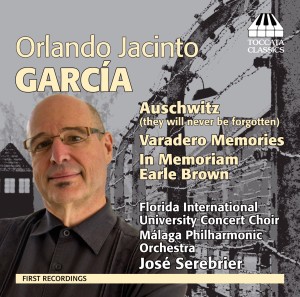
Orlando Jacinto García: Music for Chorus and Orchestra
Born in Havana in 1954, the Miami-based Orlando Jacinto García studied with Morton Feldman and has inherited some of Feldman's concerns: his music likewise evolves gradually over slow-moving spans of time, unfolding like the leaves of a plant, generating colours as with the gentle turning of a kaleidoscope. The elegiac Auschwitz (they will never be forgotten), a meditation for chorus and orchestra, captures something of the infinite sorrow evoked by the memory of such institutionalised cruelty. Varadero Memories is an abstract recollection of a Cuban beach where as a child he spent time with his grandparents. And the hypnotic In Memoriam Earle Brown pays elegant, understated tribute to a seminal figure in American modernism.
Florida International University Concert Choir, choir
Mark Aliapoulios, conductor
Málaga Philharmonic Orchestra, orchestra
José Serebrier, conductor
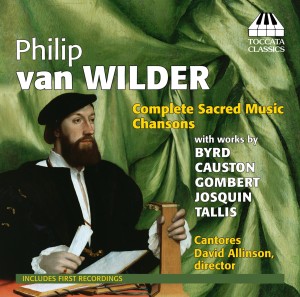
Philip van Wilder: Complete Sacred Music Chansons
Philip van Wilder (c.1500-54) was a Dutch lutenist and composer who became Henry VIII's favourite musician, and yet he has passed almost unnoticed from musical history. This recording presents his complete surviving sacred music and some of his chansons and sets him in historical context: downstream from Josquin and Gombert, collaborating with Tallis and a formative influence on Byrd.
Cantores Chamber Choir, choir
David Allinson, director
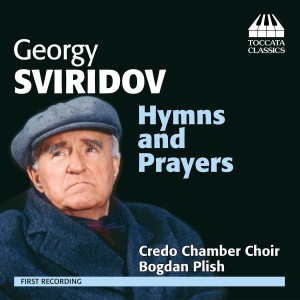
Georgy Sviridov: Hymns and Prayers
Gyorgy Sviridov (1915-98) saw himself as part of the thousand-year continuum of Russian culture, giving its resonance full expression in the monumental choral cycle Hymns and Prayers, written over a ten-year period from 1987 to 1997; he completed it only weeks before he died. Extraordinarily beautiful and profoundly moving, Hymns and Prayers is perhaps the most important Russian choral composition since the liturgies of Tchaikovsky and Rachmaninov. At this time of tension between Russia and Ukraine, here a Ukrainian choir sings a Russian masterpiece.
Credo Chamber Choir, cond. Bogdan Plish; Ivanna Bondaruk, soprano; Yuliya Zuveya, mezzo soprano; Roman (Podlubnyak), celibate deacon, tenor; Roman Pachashynsky, tenor; Nazar Yakobenchuk, baritone; Tarasiy (Mudrak), archdeacon, bass;
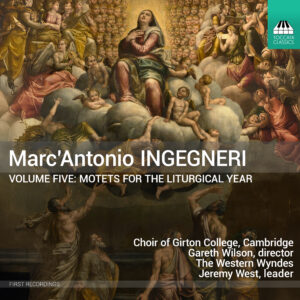
Marc’Antonio Ingegneri, Volume Five: Motets for the Liturgical Year
The Choir of Girton College, Cambridge, continues its pioneering exploration of the music of the Italian Renaissance master Marc’Antonio Ingegneri (c. 1535/36–92) with a journey through the liturgical year, as mirrored in Ingegneri’s motets. A ‘concept album’ of Renaissance polyphony may be an unusual undertaking, but this one illustrates how Ingegneri took his lead from the emotions implicit in each major celebration of the church – from sorrow and awe to joy and jubilation – expressed in music of extraordinary beauty, belying the internal complexity that gives it its emotional power.
Choir of Girton College, Cambridge
Gareth Wilson, director
The Western Wyndes
Jeremy West, leader